- The Cotswolds is one of the most filmed landscapes in Britain, doubling as Hogwarts, Tudor England, Regency-era villages, and royal estates across dozens of major productions.
- Cornerstone Cottage is in the heart of the Cotswolds, placing you within easy reach of Lacock, Gloucester, Bampton, Bibury, and more iconic filming locations.
- Lacock Village and Lacock Abbey alone have appeared in Harry Potter, Pride and Prejudice, Wolf Hall, and Downton Abbey — making it one of the most versatile filming locations in the world.
- Puzzlewood in the Forest of Dean (approx. 90 min drive) has hosted Doctor Who, Star Wars: The Force Awakens, and BBC's Merlin — a must-visit for families and sci-fi fans alike.
- This guide covers everything from booking tips and driving distances to what each location actually looks like on the ground — so you can build the perfect Cotswold film trail from your cottage door.
Your Cotswold Film Location Base Camp: What to Know Before You Go
Few places on Earth have appeared on screen as consistently, and as convincingly, as the Cotswolds. The honey-stone villages, cathedral cloisters, and rolling countryside have stood in for everywhere from medieval England to a galaxy far, far away. Cornerstone Cottage on Lower Mill Estate puts you right at the centre of it all — a beautifully positioned base from which to explore over a dozen major filming locations, many within a 45-minute drive.
Whether you're planning a dedicated film trail, hunting down Harry Potter scenes with the kids, or simply want to walk the same streets as Colin Firth and Keira Knightley, this guide lays out exactly where to go, what you'll find, and how to make the most of each visit.
The Cotswolds Is One of Britain's Most Filmed Landscapes — Here's Your Base
The Cotswolds consistently tops the list when location scouts need an untouched English village, a brooding Gothic interior, or a sweeping rural horizon. Its combination of preserved medieval architecture, National Trust-managed estates, and photogenic natural scenery means it can convincingly play almost any era. Productions from Steven Spielberg's War Horse to the BBC's Wolf Hall have all used the landscape as their canvas.
What makes Cornerstone Cottage such an ideal base is its position within the Cotswold Water Park near Cirencester. From here, you can reach Lacock in under 40 minutes, Gloucester Cathedral in around 35 minutes, and Bampton in approximately 25 minutes. The cluster of filming locations across this region is genuinely unmatched anywhere else in the UK — and having a private cottage with space for families or groups means you can plan ambitious full-day location trails without the pressure of a hotel checkout.
Harry Potter and the Philosopher's Stone (2001) — Gloucester Cathedral and Lacock Abbey
The wizarding world came to the Cotswolds long before the theme parks were built. Gloucester Cathedral and Lacock Abbey were both used extensively during the filming of Harry Potter and the Philosopher's Stone and subsequent films in the series, providing the atmospheric stone interiors that audiences around the world associate with Hogwarts School of Witchcraft and Wizardry.
Gloucester Cathedral's Cloisters as Hogwarts Corridors
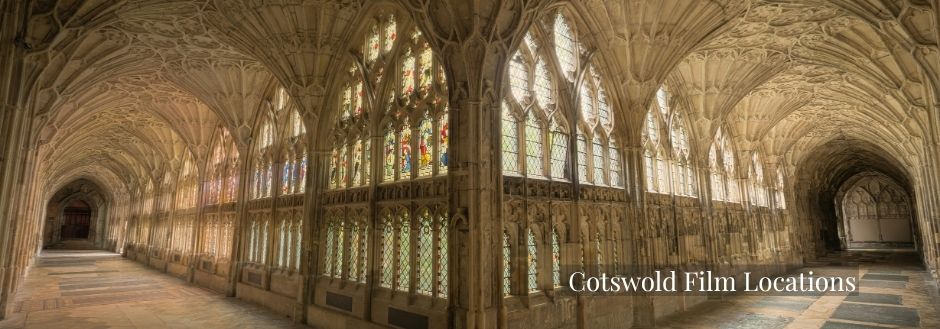
The cloisters of Gloucester Cathedral were used to film some of the most recognisable corridor scenes in Hogwarts, including the scene where Harry first encounters the writing on the wall in Chamber of Secrets. The fan-vaulted ceiling of the cloisters is immediately recognisable, and walking through them today produces a genuinely striking sense of recognition. The cathedral is open to visitors most days, though a suggested donation or entry fee applies, and guided tours are available for those who want the full context.
The cathedral also featured in Harry Potter and the Goblet of Fire, and its Chapter House has appeared in multiple productions beyond the Potter series. It is an active place of worship, so certain areas may be restricted during services — checking ahead before your visit is worthwhile, particularly during school holidays when visitor numbers are higher.
Lacock Abbey as Hogwarts Interior Scenes
Lacock Abbey, managed by the National Trust, provided interior rooms for multiple Harry Potter films. The Chapter House became the Mirror of Erised room, the Warming Room served as Professor Quirrell's classroom, and the Sacristy became Snape's Potions classroom. These are not reconstructed sets — you are standing in the actual rooms. For any Harry Potter fan, the effect is genuinely powerful.
The Abbey is open seasonally and National Trust members enter free. For non-members, entry covers both the Abbey and the grounds. The village of Lacock itself — owned almost entirely by the National Trust — can be explored at no cost, and the filming locations trail through the village streets is available as a downloadable PDF map from the National Trust website.
How Far From Cornerstone Cottage and What to Expect on Arrival
Lacock is approximately 35 to 40 minutes from Lower Mill Estate via the A419. Gloucester Cathedral is around 35 minutes heading north via the A417. A practical option for families is to combine both in a single day — spend the morning at Lacock Abbey and the village, then drive north to Gloucester for the afternoon cloisters visit. Parking at Lacock is managed by the National Trust with a pay-and-display car park near the village entrance. Gloucester city centre has multiple car parks within easy walking distance of the cathedral.
Downton Abbey (2010–2015) — Bampton Village as Downton Village
While the interiors of Downton Abbey were filmed at Highclere Castle in Hampshire, the village scenes that give the series its grounded, community feel were shot entirely in Bampton, Oxfordshire — a small market town sitting roughly 25 minutes from Cornerstone Cottage. If you watched Downton Abbey and felt a strong pull toward the idea of English village life, Bampton is exactly what you were responding to.
St Mary's Church and the Village Streets Used in Filming
St Mary the Virgin Church in Bampton served as the Downton parish church throughout the series, appearing in weddings, funerals, and countless village scenes. The church is open to visitors and a small exhibition inside details its role in the production. The nearby Churchgate House was used as the exterior of the Downton Cottage Hospital, and the village library was used as the exterior of Isobel Crawley's home.
The village streets — particularly around the church and the town square — are immediately recognisable to fans. Because Bampton is a functioning village rather than a preserved attraction, there is no entry fee, no visitor centre with queues, and no merchandise stands. You simply park and walk. That quality of quiet authenticity is exactly what made it appeal to the Downton production team in the first place.
What Fans Will Recognise on a Walking Tour of Bampton
A self-guided walking tour of Bampton's Downton locations takes approximately one to two hours at a relaxed pace. Key spots to find include:
- St Mary the Virgin Church — the parish church used for all major Downton ceremonies
- Churchgate House — exterior of the Cottage Hospital
- The Old Grammar School — appeared as a village backdrop in multiple episodes
- Ham Court Farm — used for exterior farm scenes
- Bampton Town Hall — visible in village market and street scenes
The Bampton Community Archive has produced a detailed filming locations leaflet available locally, and several fan sites offer downloadable maps. A visit pairs well with lunch at one of Bampton's pubs, making it an easy and genuinely pleasant half-day out from the cottage.
Bridget Jones's Diary (2001) — Snowshill and the Cotswold Village Scenes
The romantic countryside sequences in Bridget Jones's Diary leaned heavily on the visual identity of the Cotswolds. Snowshill, a remote and quietly spectacular village near Broadway in the north Cotswolds, provided the kind of archetypal English countryside backdrop that the film needed to make Mark Darcy's rural world believable. The village has no shop, no pub, and very little traffic — which is precisely why it photographs so well.
Snowshill Manor and Village as the Fictional English Countryside
Snowshill Manor, another National Trust property, is one of the more eccentric houses in the Cotswolds. Its collection of curiosities — including samurai armour, musical instruments, and model ships — was assembled by former owner Charles Paget Wade. The manor and its terraced Arts and Crafts gardens were used for filming, and the approach to the village along narrow country lanes gives you a strong sense of the isolated, timeless quality that location scouts were after.
Snowshill is approximately 55 minutes from Lower Mill Estate, making it a natural fit for a northern Cotswolds day trip that also takes in Broadway and Chipping Campden. The National Trust car park at Snowshill Manor is small and fills quickly during peak season — arriving before 10:30am on summer weekends is strongly recommended.
Pride and Prejudice (2005) — Lacock Village as Meryton
The 2005 film adaptation of Jane Austen's Pride and Prejudice, starring Keira Knightley as Elizabeth Bennet and Matthew Macfadyen as Mr Darcy, used Lacock Village extensively as the market town of Meryton. The same streets that appeared in Harry Potter were dressed with period market stalls, Georgian signage, and horse-drawn carriages to become Regency-era England — a testament to how adaptable this extraordinary village really is.
The Streets and Buildings of Lacock Used as the Bennet Family's World
The High Street, Church Street, and East Street in Lacock all featured in the film, with various cottages and doorways serving as background buildings in Meryton's market scenes. The absence of modern signage, cables, and road markings across almost the entire village means that period productions can begin filming with minimal dressing. Several of the specific doorways and corner buildings used in the Meryton scenes are identifiable by fans using behind-the-scenes production photographs.
Visiting Lacock Abbey and Village as a Combined Day Out
Given that Lacock appears in both Pride and Prejudice and Harry Potter — as well as Wolf Hall, which is covered later in this guide — a dedicated Lacock day makes strong sense for any serious film enthusiast staying at Cornerstone Cottage. Allocate a full day: the Abbey and grounds alone warrant two to three hours, and the village streets reward a slow, exploratory walk. The Red Lion pub in the village has been serving visitors since the 18th century and provides a natural stop for lunch.
Stardust (2007) — Bibury and Castle Combe as the Village of Wall
Neil Gaiman's fantasy adventure Stardust, directed by Matthew Vaughn and starring Charlie Cox and Claire Danes, used two of the most photographed villages in the Cotswolds to create the fictional border town of Wall — the threshold between the ordinary world and the magical kingdom of Stormhold.
|
Location |
Film |
Role in Production |
Distance from Lower Mill Estate |
|
Bibury, Arlington Row |
Stardust (2007) |
Village of Wall exterior scenes |
~20 minutes |
|
Castle Combe |
Stardust (2007) |
Additional village and street scenes |
~40 minutes |
|
Lacock Abbey |
Harry Potter (2001–2009) |
Hogwarts interior classrooms and corridors |
~40 minutes |
|
Gloucester Cathedral |
Harry Potter (2001–2009) |
Hogwarts cloisters and corridor scenes |
~35 minutes |
|
Bampton Village |
Downton Abbey (2010–2015) |
Downton village all exterior scenes |
~25 minutes |
|
Snowshill |
Bridget Jones's Diary (2001) |
Rural English countryside sequences |
~55 minutes |
Arlington Row in Bibury is arguably the most photographed street in the Cotswolds — a row of 17th-century weavers' cottages beside the River Coln that looks almost too perfect to be real. For Stardust, its ancient, slightly otherworldly quality made it ideal for a village that sits on the edge of a magical realm. Bibury is only around 20 minutes from Lower Mill Estate, making it one of the most accessible film locations on this entire list.
Castle Combe, often described as the prettiest village in England, provided additional street scenes for the same production. Its Market Cross, 14th-century church, and mediaeval cottages along the By Brook give it a quality that is noticeably different from most Cotswold villages — slightly more dramatic, more enclosed, with a strong sense of depth when filmed along its main street. Castle Combe also appeared in Doctor Dolittle (1967) and War Horse (2011), making it worth a standalone visit for serious location hunters.
Both Bibury and Castle Combe are accessible and family-friendly. Bibury has good parking near the trout farm, and the river walk alongside Arlington Row is flat and easy with younger children. Castle Combe has limited parking at the village entrance with a short walk down to the main street — sensible footwear is recommended if the weather has been wet.
Arlington Row in Bibury and Why It Was Perfect for a Fantasy Film
Arlington Row stops visitors in their tracks — and it had exactly the same effect on the Stardust location team. Built in 1380 as a monastic wool store and later converted into weavers' cottages in the 17th century, the row of gabled limestone buildings beside the River Coln has an organic, unhurried quality that no set designer could replicate. The way the buildings cluster and lean slightly into one another, the lichen on the stone, the low garden walls — all of it reads on camera as a place that exists outside normal time.
Arlington Row is owned by the National Trust and the cottages are still inhabited, meaning there is no formal visitor attraction to enter — you simply walk to it along the riverside path from the main Bibury car park. The approach along the Rack Isle water meadow, with the row reflected in the millstream, is the view that appears most frequently in both the film and in travel photography. Early morning visits in autumn or winter, when the light is low and the crowds are absent, are genuinely spectacular.
Castle Combe's Role in the Same Production
Castle Combe doubled as additional street scenery for the village of Wall in Stardust, its narrow main street and overhanging cottages providing a slightly darker, more enclosed atmosphere than Bibury's open riverside setting. The village's Market Cross — a 14th-century preaching cross at the centre of the main street — appears in the background of several scenes and is immediately recognisable once you know to look for it. Combined with a Bibury visit, Castle Combe makes a compelling west Cotswolds day trip from Lower Mill Estate.
The Crown (2016–Present) — Woodchester Manor as a Royal Stand-In
Few filming locations in the Cotswolds are as atmospherically arresting as Woodchester Manor , a vast, unfinished Victorian Gothic house hidden in a secluded valley near Nympsfield in Gloucestershire. Construction began in 1857 and was abandoned mid-build in the 1870s — leaving doorways that open onto sheer drops, fireplaces with no chimney stacks above them, and carved gargoyles sitting alongside bare rubble. It is genuinely unlike anywhere else in Britain.
The Crown used Woodchester Manor as a stand-in royal location, exploiting its cavernous stone interiors and the sense of institutional grandeur that its Gothic architecture projects. The combination of grandeur and incompletion gives it a slightly unsettling edge that period dramas find extremely useful — it suggests wealth and power while also implying something unresolved, which suits the emotional world of The Crown perfectly.
Which Scenes Were Filmed at Woodchester Manor
Woodchester Manor appeared in The Crown as interior royal spaces requiring large stone rooms and long corridors with period-appropriate architectural detail. The mansion's Great Hall, the unfinished chapel, and the stone staircases have all been used by various productions. Beyond The Crown, the mansion has appeared in Dr. Who, Sleepy Hollow, and several other productions that need an interior which sits somewhere between grandeur and gothic dread.
Visiting This Unfinished Victorian Gothic Mansion
Woodchester Manor is managed by the Woodchester Manor Trust and opens on selected weekends throughout the year, as well as for special events including bat tours — the mansion hosts one of the most significant greater horseshoe bat colonies in Britain. Entry is ticketed and pre-booking is strongly advised, particularly for weekend openings during summer and autumn.
The mansion sits within Woodchester Park, a National Trust-managed valley with a walking trail past a chain of five lakes. The combination of the mansion visit and a walk through the valley makes for a full and varied day out. It is approximately 30 minutes from Lower Mill Estate via the A419 and B4066, and the final approach through the wooded valley on foot — the mansion cannot be reached by car — adds to the sense of discovering something hidden. Children who have graduated beyond fairy tales and into gothic adventure stories tend to find it genuinely thrilling.
Paddington 2 (2017) — Paddington Bear's Cotswold Connections
While Paddington 2 was largely filmed in London, the production made use of the Cotswolds' quintessential English townscape aesthetic for sequences designed to evoke a cosy, idealised version of Britain — the same visual language that the Paddington films consistently deploy. The Cotswolds' honey-stone streets, market town architecture, and village greens align almost exactly with the visual world the production designers built around Paddington Brown's neighbourhood.
Where to Take the Kids After Watching the Film
Bourton-on-the-Water is the most family-friendly town in the Cotswolds and makes an ideal post-Paddington destination for younger visitors. The shallow River Windrush runs directly through the centre of the village, crossed by a series of low stone bridges, and children can wade in during summer months. The town also has a model village — a one-ninth scale recreation of Bourton-on-the-Water itself, built in 1937 — as well as Birdland Park and Gardens, home to over 500 birds including penguins and flamingos. It is approximately 30 minutes from Lower Mill Estate and requires very little advance planning beyond a car park space. For more on the area's cinematic connections, check out this guide to Cotswolds film locations.
War Horse (2011) — The Cotswold Countryside as Rural Devon
Steven Spielberg's adaptation of Michael Morpurgo's War Horse needed a convincing version of pre-First World War rural Devon — rolling farmland, hedgerow-lined lanes, and working countryside with no visible modernity. The Cotswolds, with its managed agricultural landscape and photogenic hill country, provided exactly that. Several locations across the Cotswold Hills were used during principal photography, alongside locations in Surrey and Dartmoor.
Filming Locations Across the Cotswold Hills Steven Spielberg Used
Castle Combe and the surrounding Bybrook Valley featured in War Horse for its Devon farmland sequences, with the valley's gentle contours and traditional field patterns reading convincingly as the West Country landscape the story demands. The production also made use of the wider Cotswold escarpment for sweeping landscape shots where the scale of the countryside needed to feel genuinely open and rural rather than managed parkland.
For visitors staying at Cornerstone Cottage, a drive through the Bybrook Valley towards Castle Combe gives you a clear sense of why Spielberg's location team chose this area. The lane approaching the village from the north, through Ford and Slaughterford, is particularly cinematic — narrow, tree-lined, and almost entirely absent of modern infrastructure. It is the kind of drive that makes the Cotswolds feel genuinely special rather than simply scenic.
Wolf Hall (2015) — Lacock Abbey as Tudor England
Hilary Mantel's Booker Prize-winning novels about Thomas Cromwell were adapted by the BBC into Wolf Hall, a six-part drama that required interiors capable of convincingly representing the palaces and great houses of Henry VIII's court. Lacock Abbey, which had already served as Hogwarts and a Regency-era village, transformed again — this time into the stone corridors and candlelit chambers of Tudor England.
The production team used Lacock Abbey's medieval cloisters, the Chapter House, and several of the connecting stone passages to create the claustrophobic, politically charged atmosphere that the script demanded. The Abbey's genuine age — its foundations date to 1232 — means that no artificial ageing is required. The worn stone floors, the uneven walls, and the quality of light filtering through narrow windows all contribute to an authenticity that purpose-built sets cannot replicate.
For fans of the series, visiting Lacock Abbey after watching Wolf Hall is a layered experience. You are simultaneously in the world of Henry VIII's court, in Hogwarts, and in a real 13th-century building that has survived for nearly 800 years. That density of historical and cultural meaning in a single location is genuinely rare.
How the Same Location Transforms Across Multiple Period Productions
Lacock Abbey's ability to serve as Hogwarts, Tudor England, Regency-era Meryton, and multiple other settings comes down to its architectural flexibility. The Abbey has distinct zones — the cloisters, the Chapter House, the Warming Room, the Sacristy, the main house — each with a different character and atmosphere. Productions dress and light these spaces differently, and the camera's selective framing means that viewers never see the same wall twice from the same angle. It is a masterclass in location versatility, and the National Trust has been careful to preserve exactly the features that make it so useful to filmmakers.
What Wolf Hall Fans Should Look For on a Visit
The cloisters are the most immediately recognisable space for Wolf Hall viewers — the long, vaulted walkways where Cromwell navigates the political world of the court were filmed here, and the low light and stone acoustics make them feel exactly as they do on screen. The Chapter House, with its circular central pillar and radiating vaulted ceiling, was used for more intimate interior scenes and is among the most architecturally striking rooms in the entire building.
The National Trust provides a room-by-room guide to the Abbey's filming history as part of the standard visitor experience, and staff are generally well-informed about which productions used which spaces. Visiting midweek during spring or autumn — outside peak school holiday periods — gives you the best chance of experiencing these rooms in something close to the quiet that the Wolf Hall production would have valued.
Puzzlewood, Forest of Dean — Doctor Who, Star Wars and Merlin
About an hour from Lower Mill Estate on the western edge of Gloucestershire, Puzzlewood is one of the most extraordinary natural environments in England — and one of the most heavily filmed. An ancient woodland growing over a network of exposed limestone scowles (Roman-era iron ore workings), it produces a landscape of mossy passageways, gnarled tree roots growing over rock formations, and dense canopy that blocks out the sky. It looks, quite simply, like somewhere magic happens.
Doctor Who Filming at Puzzlewood
The BBC's Doctor Who has used Puzzlewood on multiple occasions, exploiting its alien-feeling landscape for scenes set on distant planets and in otherworldly environments. The woodland's naturally dramatic lighting conditions — deep shadow punctuated by shafts of light — translate directly to the visual language of the programme. Several episodes from the revived series have used the scowles and woodland paths as extraterrestrial terrain.
|
Production |
Genre |
How Puzzlewood Was Used |
Audience |
|
Doctor Who (multiple series) |
Sci-Fi / Fantasy |
Alien planet landscapes and otherworldly environments |
Family / Sci-Fi fans |
|
Star Wars: The Force Awakens (2015) |
Sci-Fi / Blockbuster |
Forest planet Takodana exterior scenes |
All ages / Mainstream |
|
Merlin (BBC, 2008–2012) |
Fantasy / Adventure |
Enchanted forest and Camelot surroundings |
Family / Young adults |
|
His Dark Materials (BBC, 2019–2022) |
Fantasy / Drama |
Wilderness and parallel world exterior scenes |
Young adults / Adults |
The limestone scowles that run through Puzzlewood were formed over thousands of years as iron ore was extracted and the rock collapsed inward, creating a series of gorge-like passageways between walls of exposed rock covered in thick moss. This is the terrain that Doctor Who's production team found so useful — it requires no modification to look like somewhere entirely non-terrestrial, and the scale of the formations means a camera can find a dramatically framed shot in almost any direction.
Puzzlewood is privately owned and operated as a visitor attraction, open daily from March through to October and on selected dates during winter. Entry is ticketed and includes access to the full network of waymarked trails through the woodland and scowles, which cover approximately a mile in total. The terrain is uneven and involves steps and inclines — suitable for children who are confident walkers, but not accessible for pushchairs on the main trail. A café and gift shop are on site.
The woodland is at its most atmospheric in autumn, when the leaf canopy thins and the light reaches the forest floor at lower angles. Spring visits, when the moss is bright green and the canopy is just beginning to close, run a close second. Midsummer, when the canopy is fully closed and visitor numbers are at their highest, is the least recommended time for photographers or those wanting a quieter experience of the location.
Star Wars: The Force Awakens Forest Scenes
J.J. Abrams' Star Wars: The Force Awakens used Puzzlewood as part of the location package for the forest planet Takodana — the lush, ancient world where Maz Kanata's castle is located. The scale and density of the woodland, combined with the dramatic rock formations, gave the production team a genuinely usable base for a landscape that needed to feel both ancient and unfamiliar.
- Takodana forest sequences — exterior approach and forest floor scenes used Puzzlewood's scowle passageways
- Pinewood Studios integration — Puzzlewood location footage was combined with Pinewood set builds and digital extensions
- The moss-covered rock formations were specifically cited by the production as a key reason for choosing the location
- Puzzlewood's restricted sightlines — the way the canopy and rock walls limit how far you can see — gave the forest an appropriately mysterious and enclosed quality on camera
Standing in the same passageways where Star Wars: The Force Awakens was partially shot is a genuinely striking experience, particularly for younger visitors who have grown up with the sequel trilogy. The woodland has a quality that is hard to describe accurately in words — it needs to be walked to be understood, and even without the film connection, it would rank among the most unusual natural environments accessible to visitors anywhere in England.
From Lower Mill Estate, Puzzlewood is approximately 55 to 65 minutes via the A48 through Gloucester. The journey itself passes through the edge of the Forest of Dean, which begins to shift the landscape noticeably as you approach — the open Cotswold countryside giving way to dense mixed woodland and the dramatic ridge-and-valley terrain of the Dean. Combining Puzzlewood with a stop at Symonds Yat Rock, one of the finest viewpoints in western England, makes for an outstanding full day away from the cottage.
BBC's Merlin and the Ancient Woodland Setting
The BBC's Merlin, which ran for five series between 2008 and 2012, used Puzzlewood repeatedly as the enchanted forests surrounding Camelot. The series required woodland that felt genuinely magical rather than simply attractive, and Puzzlewood's combination of ancient trees, exposed rock formations, and enclosed mossy passageways delivered exactly that. Many of the scenes where Arthur and Merlin venture into the forest beyond Camelot's walls were filmed here, and the woodland's visual identity became closely associated with the series' aesthetic over its five-year run.
The BBC's His Dark Materials (2019–2022) also filmed at Puzzlewood, using the ancient scowles as wilderness terrain in scenes depicting the parallel worlds at the heart of Philip Pullman's story. The location's ability to suggest somewhere genuinely outside ordinary experience — without heavy set dressing or digital augmentation — made it a natural fit for a production that needed its landscapes to feel simultaneously familiar and deeply strange. For visitors who have watched any of these productions, Puzzlewood rewards multiple visits across different seasons, each one revealing a slightly different character in the same landscape.
Why Puzzlewood Is a Must-Visit for Children and Sci-Fi Fans
Puzzlewood works on two levels simultaneously. For children, it is a working adventure — the uneven paths, the rock passageways, the roots and steps and sudden openings in the canopy all make it a genuinely physical and exploratory experience that no indoor attraction can replicate. For adults and older fans who know its screen history, it carries the additional charge of recognition — the moment when a particular passage of rock or a specific arrangement of roots resolves into something you have seen on screen. That combination of physical adventure and film recognition makes Puzzlewood one of the most rewarding single locations on this entire list, and the one-hour drive from Lower Mill Estate is straightforwardly worth making.
Bourton-on-the-Water and Cirencester — Background Locations Across Multiple Productions
Not every Cotswold filming location announces itself with a famous scene or a specific memorable shot. Bourton-on-the-Water and Cirencester have both served as background and supporting locations across a wide range of productions, providing the kind of authentic Cotswold townscape that directors reach for when they need an establishing shot, a market street, or a period-dressed background without committing a large part of their budget to a single set-piece location.
Cirencester, the largest town in the Cotswolds and the one closest to Lower Mill Estate, has a particularly useful combination of Roman heritage, medieval market architecture, and Georgian town planning that covers an unusually wide range of period requirements. Its market square, parish church of St John the Baptist — one of the largest wool churches in England — and the network of streets radiating from the centre have appeared as background locations in productions ranging from period drama to contemporary television. For visitors staying at the cottage, it is also the most practical town for daily essentials, making it a natural stop that can easily absorb a film location walk alongside a morning's shopping.
Which Films and TV Shows Have Used These Towns
Bourton-on-the-Water's characteristic low bridges over the River Windrush and its unusually wide, flat village green have appeared in background sequences across multiple productions seeking an archetypal Cotswold setting. The town featured in Bridget Jones: The Edge of Reason (2004) and has served as a location backdrop for various television productions requiring a visually recognisable Cotswold village. Its accessibility and central position within the Cotswolds make it a frequently returned-to location for productions based in the region.
Cirencester's Roman amphitheatre — one of the largest in Britain, now a grassed earthwork on the edge of town — and the Corinium Museum, which holds one of the finest collections of Romano-British artefacts anywhere in England, have both been used for documentary and drama productions requiring authentic Roman-era settings. The town also sits at the junction of several Roman roads, giving it a historical weight that productions set in the ancient world find genuinely useful. A combined visit to the amphitheatre and Corinium Museum takes approximately two to three hours and works well as a half-day addition to any Cotswold itinerary from the cottage.
How to Plan Your Cotswold Film Location Road Trip From Cornerstone Cottage
Lower Mill Estate's position within the Cotswold Water Park places Cornerstone Cottage at a genuinely central point relative to the region's main filming locations. With a car — which is essential for most of these visits — you can reach any location on this list within approximately 65 minutes, and the majority within 45. The key to a successful film location road trip from the cottage is grouping locations by geography rather than by production, avoiding unnecessary doubling back across the region. For more details, check out this guide on Cotswolds film locations.
A practical approach is to think in terms of three geographic clusters from the cottage. The southern cluster covers Lacock, Castle Combe, and the Bybrook Valley — a half-day or full-day circuit heading south and west on the A419. The central cluster covers Bampton, Bourton-on-the-Water, and Cirencester — a gentler day closer to home. The northern and western cluster covers Gloucester Cathedral, Woodchester Manor , Snowshill, and Puzzlewood — a longer day requiring an early start, or best split across two separate days.
Which Locations Are Closest and Easiest for Families With Children
For families with younger children, the three most accessible and rewarding locations from Lower Mill Estate are Bampton (25 minutes, flat village walking, no entry cost), Bourton-on-the-Water (30 minutes, riverside paddling, model village, Birdland), and Bibury's Arlington Row (20 minutes, flat riverside path, easy walk). These three can be combined across a single relaxed day, or each visited individually as part of a broader Cotswold itinerary. Puzzlewood is outstanding for children aged roughly six and above who are confident walkers, but the uneven terrain rules it out for pushchairs on the main trail.
Best Locations for a Full-Day Adult or Special Interest Film Trail
For adults with a specific interest in film and television production — or those without children who want to invest a full day in the most dramatically significant locations — the Lacock full day is the strongest single option on this list. Lacock Abbey and village together cover Harry Potter, Pride and Prejudice, Wolf Hall, and Downton Abbey-adjacent period drama in a single geographic location, and the quality of the National Trust visitor experience there is genuinely excellent. A morning at the Abbey followed by a slow afternoon walk through the village, with lunch at the Red Lion, is a day that rewards exactly the kind of close, attentive engagement that serious film enthusiasts bring to location visits.
A strong alternative full-day adult circuit combines Gloucester Cathedral in the morning — allowing time to explore the full cathedral beyond the Harry Potter cloisters — with Woodchester Manor in the afternoon. These two locations, both around 35 to 40 minutes from the cottage and approximately 30 minutes from each other, share a Gothic architectural language that makes the day feel thematically coherent rather than simply logistically convenient. Book Woodchester Manor in advance and check their opening calendar before building your itinerary around it.
Tips for Visiting Locations That Require Advance Booking
Three locations on this list require or strongly benefit from advance booking: Lacock Abbey (National Trust booking recommended during peak season, free for members), Woodchester Manor (ticketed with limited capacity, book via their website), and Puzzlewood (walk-in is generally available but pre-booking recommended during school holidays and Bank Holiday weekends). Gloucester Cathedral does not require booking for standard visits but charges a suggested donation on entry. All other locations — Bampton, Bibury, Bourton-on-the-Water, Snowshill village, and the Bybrook Valley — are accessible without any booking at all.
Cornerstone Cottage Puts You at the Centre of It All
There is no better base for a Cotswold film location trip than a private cottage with space to spread out, plan your days, and return to at the end of an afternoon on location — and Cornerstone Cottage on Lower Mill Estate, set within the natural beauty of the Cotswold Water Park, delivers exactly that combination of comfort, space, and central positioning that makes ambitious multi-day film trails genuinely achievable.
Frequently Asked Questions
The Cotswolds has so many filming locations across so many different productions that first-time visitors often have practical questions about what to prioritise, how to get there, and what to expect. These answers are based on the specific position of Cornerstone Cottage on Lower Mill Estate near Cirencester.
What Is the Closest Harry Potter Filming Location to Cornerstone Cottage on Lower Mill Estate?
Gloucester Cathedral is approximately 35 minutes from Lower Mill Estate via the A417 and is the closest major Harry Potter filming location to the cottage. Its cloisters were used extensively for Hogwarts corridor scenes across multiple films in the series, including the iconic writing-on-the-wall sequence from Chamber of Secrets.
Lacock Abbey, the other primary Harry Potter filming location in the region, is approximately 40 minutes south via the A419. If you are visiting both in the same day — which is very achievable — starting at Lacock in the morning and driving north to Gloucester for the afternoon works well logistically, as it keeps the longer drive to the start of the day when energy is highest.
Can You Visit Lacock Abbey and Gloucester Cathedral in the Same Day?
Yes, comfortably. Lacock Abbey and the village warrant approximately two to three hours for a thorough visit, and Gloucester Cathedral warrants one to two hours depending on how deeply you explore beyond the cloisters. The drive between the two is approximately 35 to 40 minutes via the A350 and A419. An early start from Cornerstone Cottage — arriving at Lacock when it opens — gives you enough time at both locations without feeling rushed, and still leaves the evening free for dinner in Cirencester or at the cottage.
Are the Cotswold Film Locations Suitable for Young Children?
Most of them, yes. Bampton, Bibury, Bourton-on-the-Water, and the Lacock village streets are all flat, accessible, and manageable with younger children and pushchairs. Lacock Abbey itself involves uneven stone floors and some narrow passages that are manageable but require attention with small children. Puzzlewood is outstanding for children aged approximately six and above, but its network of steps and rocky paths is not suitable for pushchairs. Woodchester Manor involves a walk of approximately half a mile through the valley to reach the building, and the interior has open drops and uneven surfaces that require close supervision of young children — the Trust advises this on their website.
Do You Need to Book Tickets in Advance for Puzzlewood or Lacock Abbey?
For Puzzlewood, walk-in entry is available on most days, but during school holidays, Bank Holiday weekends, and popular autumn weekends, the car park fills quickly and the site can reach capacity. Pre-booking via the Puzzlewood website costs the same as walk-in entry and eliminates the risk of a wasted journey — it is strongly recommended for any visit between late July and early September or during half-term periods.
For Lacock Abbey, National Trust members can arrive without a booking on most days, though timed entry slots are introduced during peak summer weekends. Non-members should book online in advance during school holiday periods to guarantee entry. The Lacock village streets themselves require no booking at any time of year and are freely accessible seven days a week throughout the year. For Woodchester Manor , advance booking is essential — the site has limited visitor capacity and opening days are scheduled in advance, meaning a visit without checking the calendar first risks finding the mansion closed on arrival.
Which Cotswold Filming Location Is Best for Special Interest or Serious Film Fans?
Lacock Abbey is the strongest single location for serious film enthusiasts, simply because of the density and variety of major productions that have used it. In a single visit, you are standing in rooms that appeared in Harry Potter, Pride and Prejudice, Wolf Hall, and Downton Abbey — each dressed and lit differently, each serving a completely different narrative world, yet each using the same medieval stone architecture as its foundation. Understanding how a single location can serve so many different productions tells you a great deal about both the craft of location scouting and the extraordinary architectural versatility of the Abbey itself.
Puzzlewood is the strongest choice for fans of science fiction and fantasy specifically. The combination of Doctor Who, Star Wars: The Force Awakens, Merlin, and His Dark Materials across a single small woodland creates an unusually rich location experience for genre fans, and the physical nature of the site — you walk through the actual terrain rather than simply standing in front of it — gives it a tactile engagement that more formal visitor attractions sometimes lack.
For fans of prestige television drama — particularly those drawn to the world of The Crown, Wolf Hall, or similar productions — Woodchester Manor offers something genuinely distinct. Its unfinished, haunted quality sets it apart from every other location on this list, and the effort required to reach it (the advance booking, the valley walk, the restricted opening calendar) means you arrive with a heightened sense of anticipation that the building consistently rewards. It is not the easiest day out from Cornerstone Cottage, but for serious location visitors, it may well be the most memorable one.