Article-At-A-Glance: Foraging in the Cotswolds Near Lower Mill Estate
- The Cotswolds offers year-round foraging across ancient woodlands, wildflower meadows, and hedgerows — each season brings something completely different to the basket.
- Cornerstone Cottage at Lower Mill Estate sits within easy reach of some of the region's most productive foraging terrain, making it a perfect base for wild food enthusiasts.
- Guided foraging workshops like those at Heath Farm near Chipping Norton offer hands-on experiences for all skill levels, often costing between £50–£95 per person.
- Autumn is widely considered the best season for foraging in the Cotswolds, with a spectacular variety of wild mushrooms, nuts, and berries available simultaneously.
- There are golden rules every forager must know before heading out solo — and one mistake beginners consistently make could easily be avoided with the right preparation.
- Foraging can be great fun and foragers talk enthusiastically about the food they have foraged and eaten. We do encourage you to consider guided foraging, particularly if foraging for mushrooms – in order to avoid potential dangers of eating the wrong thing.
The Cotswolds is quietly one of England's most rewarding wild food landscapes — and most visitors never even notice what's growing right beside the footpath.
Whether you're staying at Cornerstone Cottage at Lower Mill Estate for a weekend or a full week, the surrounding countryside offers something genuinely rare: a landscape where ancient woodland, chalk meadow, river valley, and dense hedgerow exist within walking distance of each other. That ecological variety is exactly what makes foraging here so consistently productive across the calendar year.
The Cotswolds Is One of England's Best Foraging Destinations
Foraging isn't just a trend here — it's a tradition. The Cotswolds has a long history of communities living closely with the land, and that relationship has never fully disappeared. Local knowledge about which hedgerow yields the best sloes, which woodland floor erupts with chanterelles after August rain, and which riverbank carries wild watercress has been passed down quietly for generations.
Why the Cotswolds Landscape Produces Such Rich Wild Food
The underlying geology does a lot of the work. The Cotswolds sits on a belt of oolitic limestone, which creates the alkaline soil conditions that many of the most prized edible plants and fungi genuinely prefer. Combine that with a temperate climate, high annual rainfall, and a patchwork of habitat types — and you have a forager's landscape that stays productive from February through to December.
The diversity here is the real advantage. Within a single walk, you might move from open limestone grassland rich with herbs into a dense ancient oak woodland humming with fungi, then along a hedgerow corridor loaded with elderberry, hawthorn, and blackthorn. Each microhabitat brings its own edible species, and the transitions between them are where the most interesting finds often appear.
How Close Lower Mill Estate and Cornerstone Cottage Are to Prime Foraging Ground
Lower Mill Estate sits in the Cotswold Water Park near Somerford Keynes, a landscape defined by lakes, wetland margins, and mature tree cover. Cornerstone Cottage, one of the estate's most sought-after properties, places you directly within reach of this habitat. The Swill Brook and its surrounding water meadows, the ancient lanes running toward Kemble, and the broader network of public footpaths crossing into Wiltshire all offer productive foraging ground within a short walk or drive.
Quick Distance Reference from Lower Mill Estate:
|
Location |
Approx. Distance |
Key Species |
|
Somerford Keynes village lanes |
0.5 miles |
Blackberries, elderflower, hawthorn berries |
|
Swill Brook water meadows |
0.8 miles |
Watercress, meadowsweet, nettles |
|
Kemble ancient footpaths |
3 miles |
Wild garlic, wood sorrel, fungi |
|
Cirencester Park woodland edges |
6 miles |
Chanterelles, porcini, hazelnuts |
|
Heath Farm, Chipping Norton |
22 miles |
Guided workshops, broad seasonal variety |
What You Can Forage in the Cotswolds Each Season
The rhythm of foraging in the Cotswolds follows the land, not the calendar exactly — a cold spring pushes everything back two weeks, a warm wet autumn can trigger a second flush of mushrooms in November. But as a general framework, each season delivers its own distinct wild larder.
Spring: Wild Garlic, Ramps, and Dandelion Greens
Spring foraging in the Cotswolds begins in earnest around late February with the first appearance of wild garlic (Allium ursinum), which carpets the floors of damp ancient woodlands in dense, fragrant sweeps of bright green. The smell alone tells you when you've found a patch — a clean, powerful garlic scent rising from the ground. Leaves are best picked young before flowering, and they work beautifully in pesto, soups, and compound butters. By April, the white star-shaped flowers appear and are equally edible, with a milder flavour. Dandelion leaves, easily identified and widely available along field margins and footpaths, offer a bitter, nutritious green that pairs well with warm bacon dressings.
Summer: Elderflower, Blackberries, Chanterelles, and Porcini
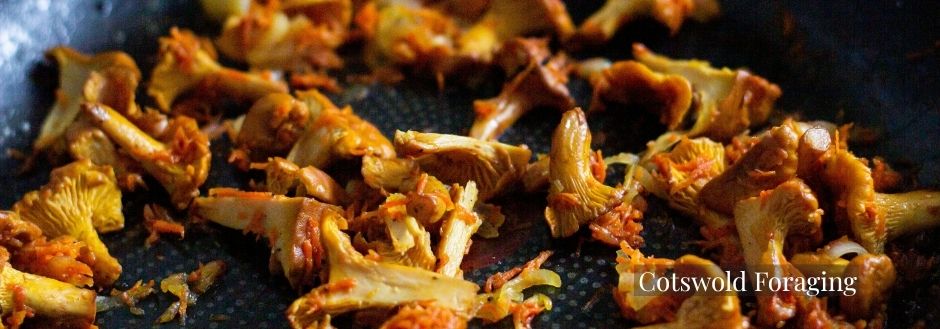
Early summer belongs to the elder tree. Elderflower (Sambucus nigra) blooms from late May through June, and the flat-topped creamy white flower clusters are unmistakable along Cotswold hedgerows. They're the basis for cordials, fritters, and infused vinegars. By July and August, attention shifts to the woodland floor as the first chanterelles begin to push through in oak and beech woodland after warm rain. Chanterelles (Cantharellus cibarius) are a golden-yellow, funnel-shaped mushroom with forked ridges rather than true gills — a key identification feature. Porcini (Boletus edulis) follow closely behind, particularly in mixed woodland with mature beech. Late August also marks the start of blackberry season, which runs well into October along almost every hedgerow in the region.
Autumn: Hazelnuts, Sloes, and a Mushroom Hunter's Dream
Autumn is the season most foragers plan their entire year around. September through November delivers the widest variety of wild food the Cotswolds offers — and the competition between foragers, squirrels, and deer is real. Hazelnuts (Corylus avellana) ripen in September and drop from the hedgerow shrubs that line many Cotswold lanes. Sloes (Prunus spinosa) — the small, intensely astringent blue-black berries of the blackthorn — are traditionally picked after the first frost, which softens their sharpness. They're the defining ingredient in sloe gin, a Cotswold cottage tradition.
The mushroom diversity in autumn is extraordinary. Beyond chanterelles and porcini, look for hedgehog mushrooms (Hydnum repandum), velvet shank (Flammulina velutipes) on dead wood, and field mushrooms (Agaricus campestris) in open grassland. The Cotswold limestone meadows are also one of the last remaining habitats in England where waxcap fungi still grow — a sign of ancient, undisturbed grassland.
Winter: Pine Needles, Juniper Berries, Nettles, and Chickweed
Winter foraging is leaner but far from empty. Young nettle shoots (Urtica dioica) push up from the base of old plants even in January during mild spells, and they're arguably most nutritious when harvested at this stage — rich in iron, calcium, and vitamins A and C. Chickweed (Stellaria media) is a cool-season plant that thrives in winter on cultivated ground and garden edges, with a mild, fresh flavour suited to salads. Juniper berries, where the trees grow on open limestone downland, can be harvested through winter and used as a spice with game and in marinades.
The Best Foraging Locations Near Lower Mill Estate
The land surrounding Lower Mill Estate is more varied than it first appears. What looks like a managed lakeside retreat opens quickly into a wider network of ancient lanes, working farmland edges, water meadow, and semi-natural woodland — all of which support different communities of edible wild plants and fungi depending on the season.
Public Footpaths and Hedgerows Worth Exploring on Foot
The public rights of way radiating out from Somerford Keynes are among the most productive foraging routes in this part of the Cotswolds. The footpath network crossing toward Ashton Keynes passes through a succession of thick hedgerows dominated by hawthorn, blackthorn, elder, and dog rose — exactly the species mix that delivers the most consistent seasonal harvests. In late summer and autumn, these corridors are loaded with haws, sloes, elderberries, and rosehips, all within a comfortable 30-minute walk of the estate. Dog rose hips (Rosa canina) are particularly worth noting here — they contain around 20 times more vitamin C than oranges and make a beautifully rich syrup.
Ancient Woodlands and Meadows Within Easy Reach
Drive 20 minutes north toward Cirencester and the character of the landscape shifts completely. Cirencester Park — one of the largest privately managed parkland estates in England — has extensive woodland edges accessible via public footpath where beech and oak provide the canopy conditions that chanterelles, porcini, and hedgehog mushrooms favour. The organic matter accumulating beneath mature beech in particular creates ideal mycelial habitat, and autumn visits here can be genuinely spectacular after a wet August.
Further afield, the ancient commons and limestone grasslands around Minchinhampton and Rodborough — both National Nature Reserves managed by the National Trust — are among the best remaining sites for waxcap fungi in the entire country. These grasslands have never been ploughed or chemically fertilised, which is exactly the condition waxcaps require. Species like the scarlet waxcap (Hygrocybe coccinea) and parrot waxcap (Gliophorus psittacinus) appear here in October and are a remarkable sight, even if you choose to admire rather than harvest them.
Guided Foraging Experiences in the Cotswolds
If you're new to foraging, joining a guided experience is genuinely the smartest first move. Not because the countryside is impenetrable without one, but because a good guide compresses years of plant identification experience into a single afternoon — and that knowledge stays with you for every future walk you take.
The Cotswolds has a well-developed network of foraging guides and workshops, ranging from half-day introductory sessions to full-day immersive experiences that end with a cooked meal made entirely from the day's finds. Quality varies, so knowing which operators are worth your time and money matters.
What a Guided Foraging Workshop Looks Like
Most guided foraging workshops in the Cotswolds follow a similar structure. You'll meet your guide at a designated woodland or meadow location, receive a safety and legal briefing, then spend two to four hours walking slowly through the landscape while your guide identifies, explains, and discusses each edible species encountered. The best sessions are hands-on — you pick, smell, taste (where safe), and handle everything rather than just observing from a distance. Many workshops conclude with a tasting or preparation session where foraged ingredients are turned into simple dishes or drinks on-site.
Group sizes are typically kept small — between six and twelve participants — which means you get genuine access to your guide's knowledge rather than straining to hear from the back of a crowd. Most operators welcome complete beginners and experienced foragers alike, pitching the content at whatever level the group needs.
Heath Farm Foraging Workshops Near Chipping Norton
Heath Farm, located near Chipping Norton approximately 22 miles from Lower Mill Estate, runs some of the most highly regarded foraging workshops in the region. Set across working farmland with access to ancient hedgerows, mixed woodland, and open meadow, the farm offers a genuinely diverse foraging environment in a single location. Workshops are led by experienced guides with deep knowledge of the local flora, and sessions run seasonally to reflect what's actually growing. Prices typically range from £65 to £95 per person depending on session length and season. Booking in advance is strongly recommended, particularly for autumn mushroom-focused sessions which fill quickly.
How to Book a Foraging Experience in the Cotswolds
Most Cotswold foraging workshops can be booked directly through the operator's website. Heath Farm takes bookings online with seasonal availability listed from late spring through to November. Other well-regarded operators in the region include Forage Fine Foods, which runs experiences across multiple Cotswold locations, and various independent guides who can be found through the Association of Foragers directory — a useful resource for finding professionally trained and insured guides anywhere in the UK.
If you're staying at Cornerstone Cottage and want to combine your foraging experience with a broader Cotswolds itinerary, booking your workshop for mid-week tends to give you better availability and a smaller group than weekend sessions, which are consistently the most popular.
What to Bring on a Foraging Trip
The right kit makes a real difference, especially if the weather turns — which in the Cotswolds, it often does without much warning. The essentials are straightforward:
- A wide, shallow basket — allows air circulation around delicate fungi and prevents fragile leaves from bruising. Plastic bags cause sweating and accelerate deterioration.
- A small folding knife — for clean cuts at the stem when harvesting mushrooms, which helps preserve the mycelium and allows regrowth.
- A soft brush — to clean soil and debris from mushrooms in the field rather than washing them later.
- Waterproof jacket and sturdy boots — Cotswold footpaths after rain are deeply muddy, and ankle support matters on uneven limestone terrain.
- A reliable field guide — Food For Free by Richard Mabey remains the gold standard for UK foraging, with clear photography and honest notes on look-alikes.
- A charged mobile phone — for navigation, emergency contact, and plant identification apps like iNaturalist or Seek as a secondary reference.
Leave the carrier bags at home. Foragers who use mesh or wicker containers inadvertently help spread spores as they walk — a small act that contributes meaningfully to the long-term health of the fungi populations they're harvesting from.
Going It Alone: Independent Foraging Tips for Beginners
Solo foraging is deeply satisfying once you have even a basic foundation of plant identification skills. The key is starting with species that are genuinely unmistakable — plants and fungi where there is no dangerous look-alike, or where the look-alike is so different that confusion is almost impossible with a moment's careful attention.
Start with these beginner-friendly species on your first independent outings in the Cotswolds:
- Blackberries (Rubus fruticosus) — universally recognisable, no dangerous look-alikes, available from August along virtually every hedgerow.
- Wild garlic (Allium ursinum) — identified by smell as much as sight; always crush a leaf and confirm the garlic scent before picking, as leaves can superficially resemble lily of the valley.
- Elderflower and elderberries (Sambucus nigra) — learn the elder tree in spring when flowering and you'll recognise it reliably through the seasons.
- Nettles (Urtica dioica) — impossible to misidentify once you've been stung; wear gloves when picking, cooking destroys the sting entirely.
- Hawthorn berries (Crataegus monogyna) — small red berries on thorny shrubs, used in jellies and syrups, widely available in autumn hedgerows.
The Golden Rules of Safe and Sustainable Foraging
Three principles underpin every responsible foraging trip, regardless of experience level. First, never eat anything you cannot identify with complete certainty — not 90% certainty, not "pretty sure." Complete certainty, confirmed against at least two identification features. Second, take only what you need and never strip a patch bare. A good rule of thumb is to take no more than a third of what's available in any one spot, leaving the rest to seed, spread spores, or feed wildlife. Third, always check land access before you pick — foraging on private land without permission is trespass, and even on public footpaths, the legal right is to walk, not necessarily to harvest.
Essential Kit for Solo Foraging in the Cotswolds
Beyond the basics already covered — basket, knife, field guide — a few additions make a solo foraging trip significantly more productive and safe. A small magnifying loupe (10x magnification) is invaluable for examining gill structure, spore colour, and surface texture on fungi where identification depends on fine detail. Many experienced foragers carry a folded piece of white paper too, used as a makeshift spore print surface in the field by resting a mushroom cap gill-side down for ten minutes.
Dress practically. The Cotswolds path network passes through dense bramble, nettles, and overgrown hedgerow — long sleeves and trousers protect against scratches and reduce tick exposure. Ticks are present in Cotswold grassland and woodland, particularly in late spring and summer, and a quick body check after each outing is simply good habit rather than cause for alarm. For those interested in exploring the area further, consider joining private Cotswold foraging tours to safely experience the natural beauty and bounty of the region.
Finally, tell someone where you're going and when you expect to be back. It sounds basic, but solo walkers in remote Cotswold woodland occasionally find mobile signal unreliable, and ancient woodland terrain can disorient even confident navigators. Download an offline OS map section for your area before you leave — the OS Maps app covers the entire Cotswolds at 1:25,000 scale and works without a signal once cached.
Foraging Near Cornerstone Cottage Is Worth Planning Your Trip Around
The Cotswolds rewards the curious. What looks like a pretty landscape of honey-stone villages and manicured countryside reveals itself, on closer inspection, as a living larder of extraordinary richness — one that changes with every season, every weather front, every shift in the light. Staying at Cornerstone Cottage at Lower Mill Estate puts you at the centre of that landscape with immediate access to hedgerow, water meadow, and ancient footpath, all within walking distance. Whether you spend a morning with a guided expert at Heath Farm or simply wander the lanes toward Ashton Keynes with a basket and a field guide, foraging here connects you to the land in a way that no other activity quite matches.
Frequently Asked Questions
Here are the questions most people ask before their first foraging experience in the Cotswolds, answered directly.
Is Foraging Legal in the Cotswolds?
Foraging is legal in the Cotswolds under the Wildlife and Countryside Act 1981 and the Countryside and Rights of Way Act 2000, but with important limits. On public footpaths and open access land, you may pick fruit, foliage, fungi, and flowers for personal consumption — not for sale. You cannot uproot any wild plant without the landowner's permission. Within Sites of Special Scientific Interest (SSSIs), which include areas like Minchinhampton Common, additional restrictions apply to protect rare species. Foraging in National Trust managed land is generally permitted for personal use in reasonable quantities. Always check specific site rules before visiting.
What Is the Best Season to Forage in the Cotswolds?
Autumn — specifically September through to early November — is the most productive single season for foraging in the Cotswolds. The combination of wild mushrooms, hazelnuts, sloes, rosehips, elderberries, and blackberries creates a simultaneous abundance that no other season matches. That said, spring runs a close second for sheer excitement, particularly when ancient woodland floors disappear under drifts of wild garlic in April. The honest answer is that each season has its own compelling reason to be outside with a basket.
Do I Need Experience to Join a Guided Foraging Workshop?
No experience is needed whatsoever. Every guided foraging workshop operating in the Cotswolds — including Heath Farm's sessions near Chipping Norton — is designed to accommodate complete beginners. Guides start from first principles, covering basic plant identification, safety rules, and sustainable harvesting practices before anyone picks anything.
If anything, coming with no prior knowledge is an advantage. Beginners tend to look more carefully, ask better questions, and absorb identification details more thoroughly than people who arrive with half-formed assumptions about what they think they already know. The most dangerous foragers are the overconfident ones, not the beginners.
How Far Are the Best Foraging Spots From Lower Mill Estate?
The closest productive foraging ground begins essentially at the estate boundary. The footpath network around Somerford Keynes and along the Swill Brook offers hedgerow and water meadow foraging within a 10-minute walk. For woodland fungi and more diverse species, a short drive opens up considerably richer terrain.
|
Foraging Location |
Distance from Lower Mill Estate |
Best Season |
Key Species |
|
Somerford Keynes lanes |
0.5 miles |
Summer – Autumn |
Blackberries, elderberries, hawthorn |
|
Swill Brook water meadows |
0.8 miles |
Spring – Summer |
Watercress, nettles, meadowsweet |
|
Ashton Keynes footpaths |
2 miles |
All seasons |
Wild garlic, rosehips, sloes |
|
Cirencester Park woodland edges |
6 miles |
Autumn |
Chanterelles, porcini, hazelnuts |
|
Minchinhampton Common (NNR) |
14 miles |
Autumn |
Waxcap fungi, field mushrooms |
|
Heath Farm, Chipping Norton |
22 miles |
Spring – Autumn |
Guided workshops, broad seasonal variety |
For a day dedicated entirely to foraging, pairing a morning session at Cirencester Park woodland edges with an afternoon along the Ashton Keynes footpaths gives you two completely different habitat types and a genuinely varied harvest across a single day.
If you're planning around the guided workshop at Heath Farm specifically, allow around 30 minutes' drive from Lower Mill Estate via the A429 north toward Chipping Norton. The drive itself passes through some of the most classically beautiful Cotswold countryside — rolling wold, dry-stone walls, and wide open skies — and it's worth leaving early enough to stop and walk a hedgerow section en route.
What Wild Foods Are Easiest to Identify for Beginners?
The easiest wild foods to identify with confidence are those that combine distinctive appearance, distinctive smell, or a combination of both — and where no dangerous look-alike exists in the UK. Blackberries are the classic starting point: every person who has spent five minutes in the British countryside already knows them by sight. Nettles are equally unmistakable, confirmed instantly by their sting. Wild garlic is identified as much by its powerful scent as its appearance — crushing a leaf and detecting that clean garlic smell removes almost all risk of confusion with other plants.
Elderflower is an excellent introduction to tree identification. The elder's compound leaves, corky bark, and flat-topped cream flower clusters are distinctive enough that a single good look at the tree in flower makes it recognisable for life. Learning it in spring when flowering means you'll also recognise it in autumn when the berries appear — a two-for-one identification that rewards the effort immediately.
For fungi, the absolute beginner's entry point is the giant puffball (Calvatia gigantea) — a white, football-sized sphere with pure white flesh throughout when sliced, found in meadows and woodland edges in late summer. It has no dangerous look-alike at full size, and its identification is essentially foolproof when you slice it open and confirm uniform white flesh with no internal structure visible. After puffballs, move to chanterelles, then hedgehog mushrooms — both are forgiving species with features distinctive enough to identify reliably after a guided introduction.
Cotswolds Concierge specialises in curating exceptional Cotswold experiences — from arranging guided foraging workshops to recommending the finest seasonal itineraries for guests staying at properties like Cornerstone Cottage at Lower Mill Estate.
Cotswold Foraging - near Cornerstone Cottage Lower Mill Estate. Seasonal guide, with locations and prices for guided experiences.